
Wolfram Alpha

Wolfram Alpha, an Artificial Intelligence engine that will be used to answer factual questions, is one of the most innovative and ambitious projects I’ve come across. It’s not coming out until May, but details are emerging about what will surely be a major player in the future of the web.

From Nova Spivak, who met with Stephen Wolfram to discuss the project:

Where Google is a system for FINDING things that we as a civilization collectively publish, Wolfram Alpha is for ANSWERING questions about what we as a civilization collectively know. It’s the next step in the distribution of knowledge and intelligence around the world — a new leap in the intelligence of our collective “Global Brain.” And like any big next-step, Wolfram Alpha works in a new way — it computes answers instead of just looking them up.

More information from Wolfram’s blog:

And in effect, we can only answer questions that have been literally asked before. We can look things up, but we can’t figure anything new out.

So how can we deal with that? Well, some people have thought the way forward must be to somehow automatically understand the natural language that exists on the web. Perhaps getting the web semantically tagged to make that easier.

But armed with Mathematica and NKS I realized there’s another way: explicitly implement methods and models, as algorithms, and explicitly curate all data so that it is immediately computable.

It’s not easy to do this. Every different kind of method and model—and data—has its own special features and character. But with a mixture of Mathematica and NKS automation, and a lot of human experts, I’m happy to say that we’ve gotten a very long way.

And finally, a HackerNews testimonial:

I had a chance to see this in action a while back. While I, and none of the people I saw this with, were not at all impressed by NKS, this project blew our minds. We watched as it pulled up and manipulated everything from Egyption fraction expansions to historic weather data to the human genome. If the author of this article is exaggerating, it’s not by a whole lot. While Wolfram may not be bringing about the revolution in science he hoped to, don’t forget that he and his crew made Mathematica, and are very capable of creating impressive software.
Make Something Mothers Want

Here’s an excellent response to a video by Andrew Wagner, who made a killing selling online greeting cards:

My mother pays something like $50 a year for online greeting cards. Do the quick extrapolation on how many mothers there are in America, how many of them use the Internet, and how many you can reasonably convert. Yeah, $40 million for a market leader doesn’t seem that unreasonable now does it.

You will not get invited to give conferences at The Future Of Web 3.0 2012 if you make greeting cards. Nobody will ask you for your insights on scaling, principally because at your scale it will be a boring engineering problem with well-understood solutions. You’ll just put smiles on a few mothers’ faces and, oh, well, there might be a little bit of money involved.

I think I’ve mentioned this a few times, but to say it one more time: grown women have money, too, and nobody in tech wants it. Instead of building stuff they want and charging money for it (money they have and spend), we want to push CPM levels to about a quarter (trending towards dimes!) while making social networks for the same people who are already members of six.

There’s a huge lesson there: you don’t have to make something shiny. Just make something that people will use.

Carnegie on Making Something People Want

There are a lot of parallels between writing well, speaking well, and good web design.

Take the following, for instance, from Dale Carnegie’s the Quick and Effective Way to Effective Speaking:

Some years ago I wrote a series of articles for the American Magazine, and I had the opportunity of talking with John Siddall, who was then in charge of the Interesting People Department.

“People are selfish,” he said. “They are interested chiefly in themselves. They are not very much concerned about whether the government should own the railroads; but they do want to know how to get ahead, how to draw more salary, how to keep healthy. If I were editor of this magazine,” he went on, “I would tell them how to take care of their teeth, how to take baths, how to keep cool in summer, how to get a position, how to handle employees, how to buy homes, how to remember, how to avoid grammatical errors, and so on. People are always interested in human interest stories, so I would have some rich man tell how he made a million in real estate. I would get prominent bankers and presidents of various corporations to tell the stories of how they battled their ways up from the ranks to power and wealth.

Shortly after that, Siddall was made editor. The magazine then had a small circulation. Siddall did just what he said he would do. The response? It was overwhelming. The circulation figures climbed up to two hundred thousand, three, four, half a million.  Here was something the public wanted. Soon a million people a month were buying it, then a million and a half, finally two million. It did not stop there, but continued to grow for many years. Siddall appealed to the self interests of his readers.

Want to make something that people want? Make something that appeals to their self interests.

Domain Pigeon Adds the # of Google Search Results

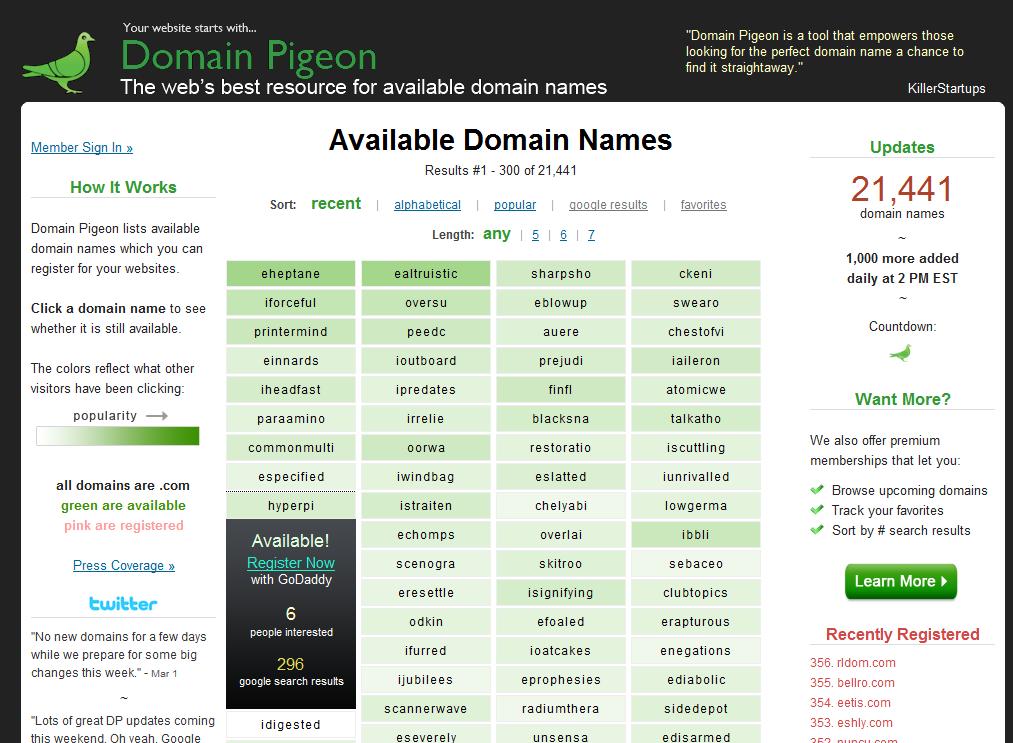
Latest layout:

Things to notice:

  • Clicking a domain now displays the approximate number of Google search results for that term. You can’t, however, sort by it unless you sign up for an account, which brings me to the next point…
  • Paid accounts are back, but with a twist. Originally accounts enabled people to see more domain names than casual visitors. I did away with that about two weeks ago so that I could make the domains available to everybody. I realized that there are a few features that heavy users might find useful, which is who these accounts are for. Those features are currently: 1) The ability to sort by the number of Google results, 2) Track your favorites, 3) See the domains scheduled for the next release
  • Quotes were moved to the top of the page and they change every 30 seconds. Doing this will result in more people seeing them (and getting them curious about the site???), will let me display more quotes (since they update I can have dozens if I wanted) and it frees up some space on the left column
  • I tweaked the algorithm that calculates the shades of green, resulting in slightly brighter colors
  • No more hovering over domains–back to clicking

Theoretically there should be a correlation between the shades of green and the quality of the domains, but how do you get people to click on the good domains? Until today the only incentive people had was to see how many other people clicked on it, but that was already reflected in the color. You also would be able to double check that the domain was still available, but, most of the time that’s going to be true.

Adding the number of search results should encourage people to click around. Hopefully, visitors will be curious about how many search results domains have so they’ll click to find out. Since people will click on the ones that seem interesting, those should be the ones that stand out over time.

I’ll be the first to admit that the number of Google search results is not a great predictor of quality. For example, when you google ” hackerer “ 333,000,000 results are returned. Seems fantastic until you realize that those are the number of results for “hacker” and not “hackerer”.  Google auto-corrects the query and returns the new phrase’s results. I considered checking for this, but it’s is tricky.

Consider “ejellyfish”. Google also auto-corrects that, but there are also some legitimate results for eJellyfish. How do you distinguish? In the end I just said screw it, I’ll return whatever it displays. Maybe that was a mistake, hard to say.

There’s another obvious problem. “psycholog” will return hits for pages that contain the word “psychology”. I tried to mitigate that by including spaces around the phrases when I googled them, but, that didn’t help ina lot of cases.

Regardless, I’m happy with the new featuer. I’m sure there are clever ways to filter the results to find great domains. Maybe the domains that have between 5K and 7K results would generally make great domain names. I’ll let ambitious visitors figure that out.

I’m very happy with the way the site looks. Over the next few days I’m going to completely automate the entire process from searching for available domains to googling to posting on Domain Pigeon. Currently each of those processes is automated but their not tied together. For example, I still have to manually go into Domain Pigeon’s admin area and add new domains.

I want to get it to the point where I can leave for say, three weeks, and assuming no power outages or anything like that, Domain Pigeon still gets updated while I’m gone.