
I Eliminated the Free Plan from my Web App for a Month: Here’s What Happened.

Background

In January 2010 I launched Preceden, a free web-based timeline tool. In May I migrated to a freemium plan, where users could add a certain number of events for free but had to upgrade to the pro plan in order to create more than that. After some experimentation with different limits and prices, I settled on 5 events for free and a one time payment of $30 to upgrade to the pro plan.

In June I started working on jMockups, a web-based high fidelity mockup tool. From June until the beginning of December I hardly touched Preceden. At the beginning of December I started reviewing Preceden’s stats and realized Hey, this is actually bringing in some decent money so I decided to start dedicating some time each week to working on it. (For a more detailed explanation of why I wasn’t watching it closely, read my 2010, 2011, and a $4K/month challenge post.)

Removing the Free Plan

Looking over the revenue figures I wondered: What would happen if I completely removed the free plan? Instead of a user being able to create 5 events for free, new users would have to pay first to use it.

After about three minutes of planning, I decided to go ahead and implement the change.

Additional Changes

I wanted to change as little as possible so that the results of the experiment would be accurate. After all, you can’t change several variables at once and then attribute the changes to only one.

That being said, I made a few small changes to the site which may have affected the results.

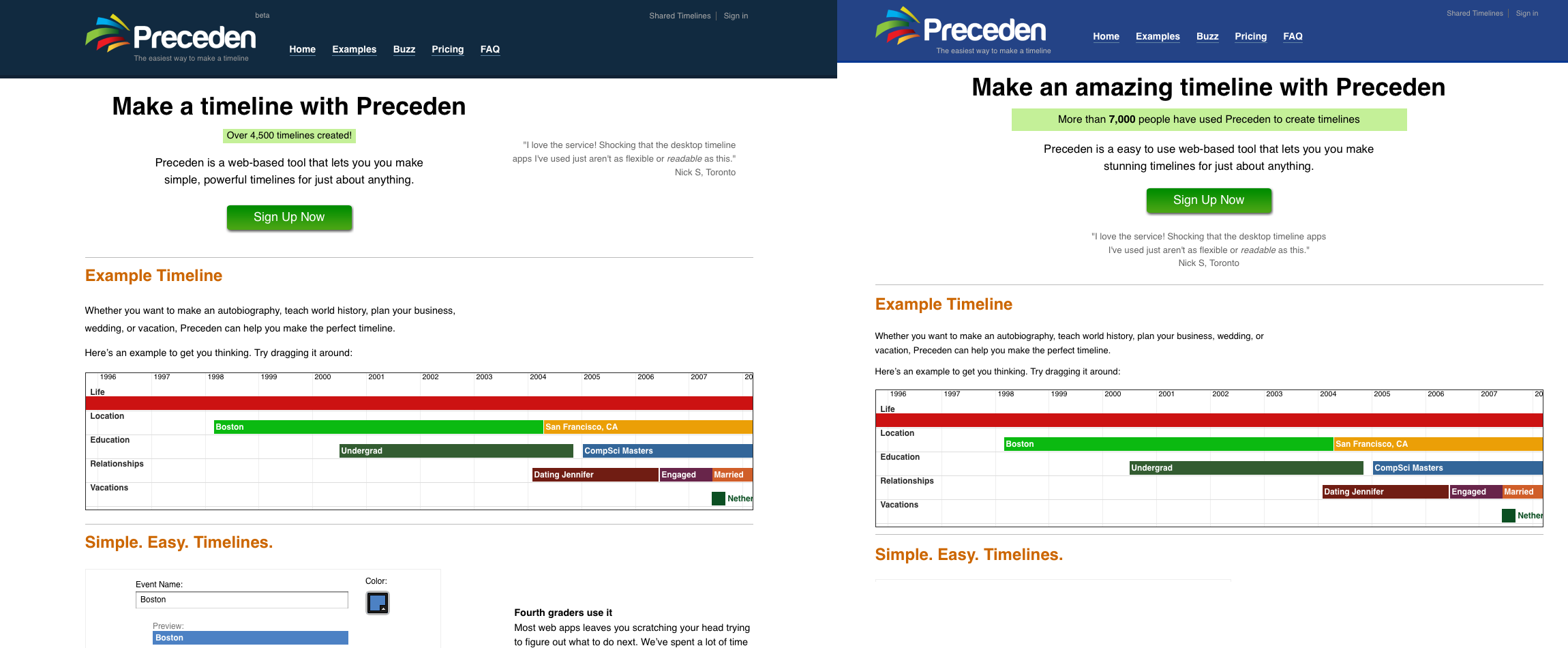
1) I dropped the price from $30 to $29

2) I changed the background color the header from #112a40 (dark blue) to #244386 (a lighter blue) and reduced its height

3) I made some layout and copy changes on the homepage

4) I removed the reCAPTCHA form from the sign up page

I shouldn’t have made these changes, but at the time I was more focused on the potential increase in revenue than on running a proper experiment.

Before and After Screenshots

Click to view full size:

Homepage
Sign Up Page
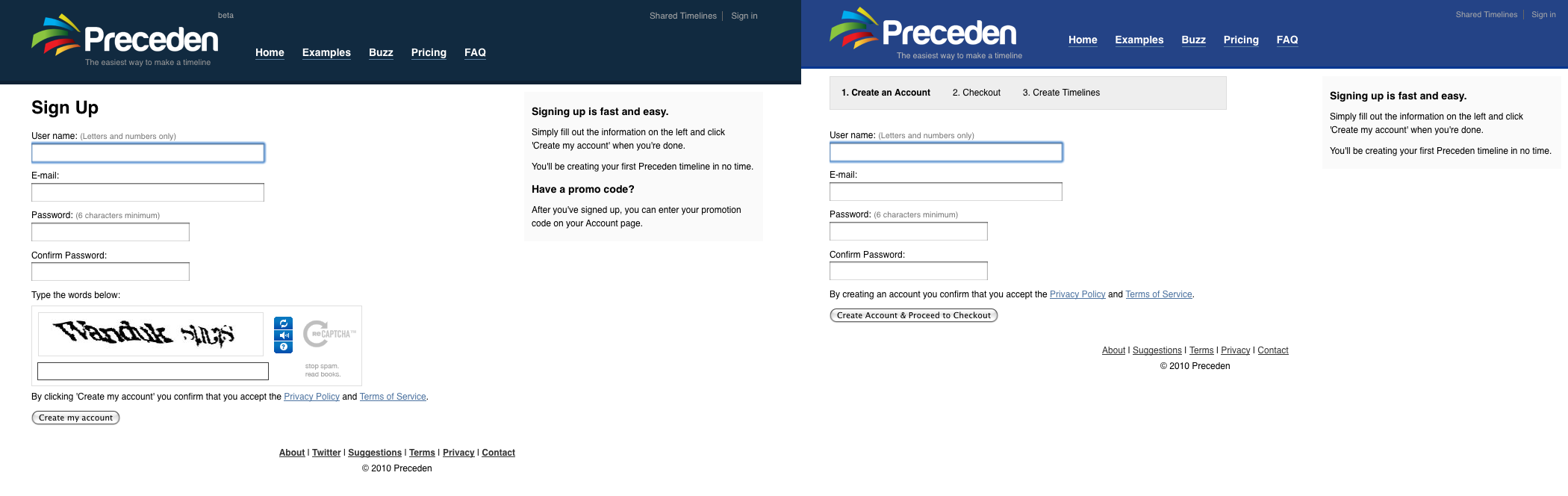
Notice at the top of the new sign up page it indicates what step of the process you are on (1. Create an Account, 2. Checkout, 3. Create Timelines). I also changed the copy on the button from “Create my Account” to “Create Account and Proceed to Checkout”. The wording will come into play later.

Checkout Page

(Only present on the pay-first version)
Results and Analysis

Notes

  • The number of homepage and sign up page visitors was taken from Google Analytics by looking a the number of new visitors to those particular pages.
  • Promotions refers to users I upgraded because they are bloggers and bloggers can get upgraded to the pro account for free.

Analysis

From Nov 1 – Dec 4, 3287 new visitors came to the Preceden homepage, 894 visited the sign up page, 567 created an account, and 22 upgraded to a paid account. That’s a 0.67% conversion rate from new visitor to paid user.

From Dec 6 – Jan 1, 3343 new visitors came to the site, 528 visited the sign up page, 210 created an account (oops), and 5 upgraded to a paid account. That’s a 0.15% conversion rate.

Users who were able to test Preceden before paying were 347% more likely to upgrade to a paid account than those who weren’t.

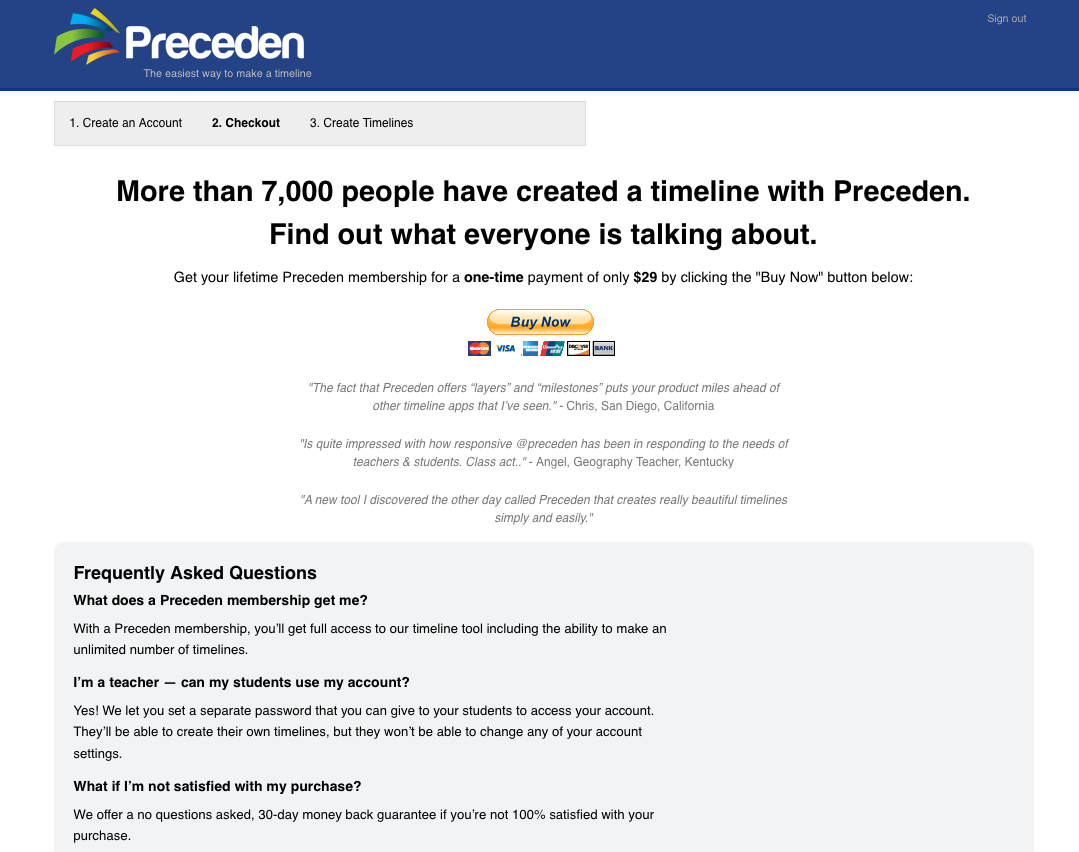
Also — and this is definitely my fault — 205 people filled out the sign up page and then abandoned the process on the Checkout page. Why? Most people probably didn’t realize they had to pay before using it. Sure, the Pricing page said “$29 for Unlimted Access” without mentioning a free account and Step #2 of the sign up process was called “Checkout”, but overall the copy didn’t clearly indicate that you had to pay before you could use the app.

Another problem is that the site doesn’t include a demo. It includes examples, but nothing the user can create on their own. Adding a demo section so that new users can get that “Oh cool” moment would have gone a long way.

The good news is that about 4% of the people who created an account converted to the paid plan when they were able to test the product first. Even if the pay-first experiment resulted in better figures, I feel more comfortable letting users test the product before paying. I think this depends a lot on your app and your business model, but for a tool like Preceden there’s no reason not to let people try it for free first. Accordingly, I’m switching back to the freemium version starting today.

Lessons Learned

  • If you run a web app and start building a new product, don’t neglect what you’ve already built. Dedicate some time each week to analyzing your key performance indicators and to making small changes — they’ll add up in the long run.
  • The best way to test this would have been to run the experiment on a fraction of visitors to the site. For example, show a pay-only version to half of the visitors and a free plan version to the other half.
  • Don’t change several variables at once when you run an experiment. Every change you make will affect the results.
  • The time of the year matters. Measuring only the number of paid users would be a bad way choice because a lot of the customers are teachers and I don’t imagine a lot are on the market for a new teaching tool in December. Measuring the conversion rates is better, but there still may be a “Oh I’ll wait till after the holidays to pursue this” mentality among some of the visitors, which could have affected the results. Running this experiment simultaneously would have yielded better results.

Over the next few weeks I’m going to experiment with A/B testing and AdWords to see what’s possible. I’m also going to email the 205 people who signed up during this experiment but didn’t pay; I’m sure they’d be interested in trying it out.

Can you think of anything else that might improve the conversion rates? Leave a comment below and I may test it out.

###

If you enjoyed this post, you should subscribe to the RSS feed for this blog to get future updates. Also, if you’re a web designer or developer I’d love to get your thoughts on jMockups, my new web design startup. Drop me a note at matthew.h.mazur@gmail.com or @jmockups on Twitter. Thanks!

How to List Your WordPress Posts by Category

There’s a nifty WordPress plugin called List Category Posts that makes it dead-simple to list all of the blog posts in a specific category of your blog.

Why is this useful? If you’ve been blogging for a while you’ve likely got a lot of valuable posts buried on your blog that aren’t easily accessible to new visitors. Most bloggers include a list of categories on the side of their blog, but if you’ve got a lot of items filed under a category it can take a while to peruse them all the posts. By creating a a list of posts sorted by category, you can point new visitors so they can get familiar with your site; it acts as a site map.

Your should create a blog post that lists all of your blog categories with a list of posts below them. Then include a link to it somewhere prominently on your site so new visitors can quickly scan your old posts.

You can see the list of posts I created for this blog here. And here’s what the post itself looks like:

The name attribute refers to the category name (make sure you put categories that have multiple words in quotes), numberposts specifies how many posts you want to be displayed for that category (-1 means list everything), and date tells it to display the post date next to the link.  You can see all the options on the plugin’s Other Notes page.

And the great thing about this is that it will update automatically as you add new posts.

To add a link to your side bar, go to Appearance > Editor > Sidebar and add a link to that blog post:


Enjoy!

Startup Blogs To Make You a Better Entrepreneur

As an aspiring startup founder, I’m always on the lookout for blogs that will help me become a more adept entrepreneur.  Fortunately for me and for the startup community there’s a lot of really talented entrepreneurs who write regularly about what they’ve learned so you can benefit from their experiences.

The following is a list of the best startup blogs that I’ve run across, which I thought I’d share in the hope that you find something new for your collection. In no particular order…

  1. Derek Sivers – Founder of CD Baby and several other companies, the word “wise” comes to mind. His post Let pedestrians define the walkways is always in the back of my head while I’m working on my startup.
  2. Gabriel Weinberg – Ballsy Philadelphia-based founder of Duck Duck Go, an inspirational (and quite successful) one-man search engine startup. Really nice guy too.
  3. IIlya Lichtenstein – Internet marketer who recently helped more than 150 startups with their marketing efforts and wrote about the lessons learned in a series of great blog posts.
  4. Jason Baptiste – Boston-based cofounder of PadPressed. His posts on startups are some of the best I’ve read. See, for example, If You Build It, They Won’t Come (something I’ve learned the hard way) and 16 Ways Your Startup Needs to be Getting Customers.
  5. Eric Ries – Eric has changed the way people approach building startups with the Lean Startup movement. He also coined the phrase Minimum Viable Product, which is now common lingo in the startup world.
  6. Ben Cashnocha – An all around brilliant guy, he writes on topics including entrepreneurship, travel, and philosophy.
  7. OnStartups – By Dharmesh Shah and others, it offers troves of invaluable advice for startup founders in posts that always seem to begin with a number.
  8. Jason Cohen – Another very successful startup founder who writes about how to do it well. Rich vs King: Why I Sold My Company and Why I feel like a fraud are great places to start.
  9. Paul Graham of Y Combinator fame — his essays are essential reading for startup founders.
  10. Rob Walling – Software by Rob is a new addition to the list. I recently read his new book Start Small, Stay Small and immediately identified with his approach. Highly recommended for anyone running or aspiring to run a small online business.
  11. Matt MaroonFormer poker player turned YC-backed startup founder of Blue Frog Gaming, Matt excels at seeing the big picture and articulating it for his readers (just not on HackerNews).
  12. Chris Dixon – Cofounder of Hunch and active angel investor who writes on investing, technology, social media, etc.
  13. Mixergy – An excellent series of interviews by Andrew Warner, who relentlessly pursues the execution details behind many successful startups.
  14. Sebastian Marshall – Sebastian offers practical advice drawn from a breadth of knowledge and experience on how to excel at just about anything. Here‘s an inspiring post from yesterday and here‘s a list of his top posts.
  15. Balsamiq Products Blog – The more I work on jMockups, the more impressed I am with Balsamiq’s incredible execution. Too bad I’m going to destroy them (just kidding… maybe). :)
  16. Steve Blank – Former Air Force officer turned Silicon Valley serial entrepreneur, Steve invented the Customer Development process which is the foundation of the Lean Startup movement.
  17. Patrick McKenzie – Of Bingo Card Creator and soon-t0-be Appointment Reminder fame, he inspired me to create Preceden, a web-based timeline tool.
  18. Spencer Fry – Creator of Carbonmade, a site for designers that lets you show off your portfolio, who writes about entrepreneurship, freemium, and more.
  19. Jacques Mattheij – A pillar of the HackerNews community and thought leader in earning money from web apps, Jacques’s blog is not one to miss.
  20. Daniel Tenner – Cofounder of Woobius, who puts things in perspective with posts like iPad: Apple for Mom and The questionable value of the real time web.
  21. This Week in Startups with Jason Calacanis
  22. Furqan Nazeeri – Boston-based serial entrepreneur who writes about startups, venture capital, and entrepreneurship
  23. Seth Godin – Seth is a brilliant marketer and businessman who shares his seemingly endless supply of insights via his blog. He’s also got some great books including  Small is the New Big and The Purple Cow.
  24. Mark Suster at BothSidesOfTheTable – Musing of an entrepreneur turned venture capitalist. I came across his blog via his post How to Talk to Investors About Your Competitors.

And two non-startup blogs that you might also like:

  1. Less Wrong – Less Wrong is about how to think better–a lot of it will make you go whoa. For example, check out Intellectual Hipsters and Meta-Contrarianism.
  2. David Mangold – Dave is a big picture, outside-of-the-box intellectual who writes about topics including evolution, astrobiology, metaphysics, and more.

Know of a blog that might make a good addition to this list? Let me know in the comments below.

Cheers!

Determining Your Values with Hypothetical Extremes

To be happy is an enormous achievement because it entails working very hard to learn what one needs to be happy and most people choose the incorrect things. – Marty

My great uncle and I have had a long running email conversation about life, philosophy,  happiness, and the like. One of the tenents of his philosophy, which is based heavily on the works of Ayn Rand and Nathanial Brandon, is that happiness is a consequence of living your life in a way that’s aligned with your values, which in turn should be based on your own rational self interest.

Determining your values can be a daunting task if you’ve never done it before but I highly encourage you to take some time and figure them out if you’re not sure. I came up a simple way of determining my values that works pretty well for me so I thought I’d share it with you all in case you’re having trouble:

1. Start by identifying one thing that you value. It doesn’t have to be the most important thing, but it should be something that you would say “Yeah, that’s important to me.”

2. Imagine a hypothetical life where that’s the only thing in your life. Would you be happy if that’s all you had?

3. If not, ask yourself why? What’s missing? Add that to your list of values and repeat these steps until you’ve got a life that you’d be happy with.

The list of things that make up this hypothetical world is what you value.

Here’s an example for me:

I enjoy making things. Would I be happy in a world where all I did was make things? No. It’s not enough to simply make something. It has to be something new and creative.

So I want to make new, creative things. Would I be happy in a world where that’s all I did? No. If I have someone telling me new, creative things I should make I wouldn’t be satisfied. I have to have the independence to make what I want.

So I want to make new, creative things (ie. innovate) without anyone dictating my actions or direction. Would I be happy in a world where I was an independent innovator? No. I could sit in a dimly lit room all day making cool things with legos, but I wouldn’t be happy. The things I build have to have some impact on the world.

So I want to be an independent innovator who creates things with impact. Would that be enough? What if I could change hundreds of lives but no one would ever know it was me? Recognition isn’t paramount, but I find that I would like some recognition for my work. I don’t want to be anonymous.

So I want to be a recognized independent innovator who creates things with impact. Getting there. Would it be enough to do this completely alone, without any friends or family? No. I want those things too.

So I want to be a recognized independent innovator who creates things with impact who also has a great family and friends. Yeah, that sounds pretty good to me. It’s not perfect: I could continue adding other things (physical and mental health, education, self improvement, integrity, etc), but you get the idea.

By following this simple little algorithm you can determine with high fidelity what your values are. It won’t tell you whether these things are in your own self interest (ie, you might imagine a world where you’ve got an endless supply of cocaine to get high on), but it will help you identify what’s important to you.

Give it a shot. See what you come up with.  Figure out how you’re going to get there, then do it.