As a web developer who is also interested in A/B testing and evolution, it occurred to me that it would be fascinating to try to build a website that optimizes itself. I’ve been kicking around this idea for a while and wanted to share a few thoughts on it here to get feedback from anyone else that finds the idea promising.
Here’s the idea:
In traditional A/B testing, you specify multiple variations of some aspect of your site, measure which variation performs the best, then make the winner the default, and repeat. The types of things you test can range from simple headline and button color tests to complex tests that affect the user’s entire experience with your site.
In all of these cases though you have to figure out what variations you want to test. If you’re testing the headline, you need to specify which headlines you want to test. If you’re testing button color, you need to specify which colors to test, etc.
In the natural world, we see stunningly complex and optimized life forms that evolved little by little over billions of years. Evolution is similar to A/B testing in a sense, except that in evolution the variations happen by accident through genetic copying errors. Most of those mutations decrease the organism’s odds of reproducing, but occasionally they confer a benefit that causes that organism to have a better chance at surviving and reproducing. When that happens, the mutation gets passed on and may eventually spread to the rest of species over time. That “simple” process is what has led to all of the variety of life on earth.
Optimizing a web page through evolution poses many issues though.
How do you algorithmically mutate something on the page? Could you write a function that generates variations of a headline? Maybe. Would those variations be any good? Would you trust it enough to deploy into production?
I bet by analyzing tens of thousands of webpages, you could algorithmically identify common headline wording structures. Then maybe you could write code that intelligently customizes those headlines to your service.
You might be able to do the same with design. If you tried to categorize hundreds of homepage layouts, I expect you’d probably wind up with 20-30 common layouts that cover 90%+ of websites. Could you then write an algorithm that automatically tweaks your site’s layout to test these different layouts on your visitors? Could you do the same with color schemes? Maybe.
There’s also the problem of statistical significance. Running a simple two variation A/B test can take a long time if you don’t get a lot of traffic. Trying to get significant results for lots of algorithmically generated headlines might take forever. But maybe there are ways around that like the multi-armed bandit algorithm.
To sum it up, I think you’d need the following: a way to intelligently generate mutations on headlines, buttons, layout, etc + a ton of traffic or some novel method for picking the best variations + an organization that is willing to try such an experiment. It would not be easy, but I think it’s possible.
Imagine if it did work. Maybe your homepage converts users into sign ups at 10% now. You flip a switch, and in 6 months it increases your conversion rate 30% without any intervention on your part.
Backpropagation is a common method for training a neural network. There is no shortage of papers online that attempt to explain how backpropagation works, but few that include an example with actual numbers. This post is my attempt to explain how it works with a concrete example that folks can compare their own calculations to in order to ensure they understand backpropagation correctly.
Backpropagation in Python
You can play around with a Python script that I wrote that implements the backpropagation algorithm in this Github repo.
Continue learning with Emergent Mind
If you find this tutorial useful and want to continue learning about AI/ML, I encourage you to check out Emergent Mind, a new website I’m working on that uses GPT-4 to surface and explain cutting-edge AI/ML papers:
In time, I hope to use AI to explain complex AI/ML topics on Emergent Mind in a style similar to what you’ll find in the tutorial below.
Now, on with the backpropagation tutorial…
Overview
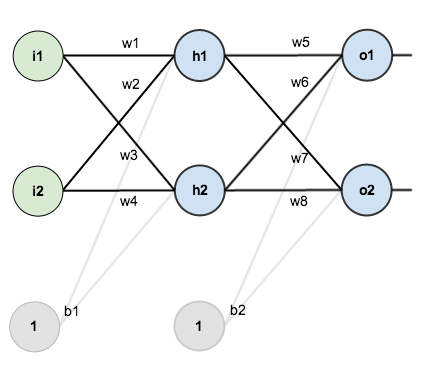
For this tutorial, we’re going to use a neural network with two inputs, two hidden neurons, two output neurons. Additionally, the hidden and output neurons will include a bias.
Here’s the basic structure:
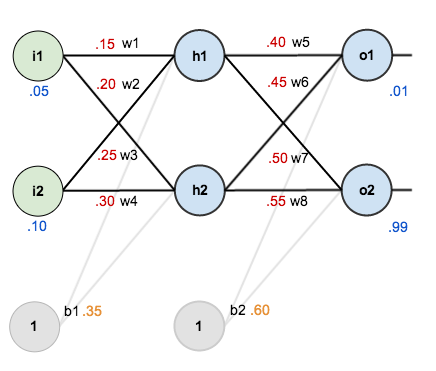
In order to have some numbers to work with, here are the initial weights, the biases, and training inputs/outputs:
The goal of backpropagation is to optimize the weights so that the neural network can learn how to correctly map arbitrary inputs to outputs.
For the rest of this tutorial we’re going to work with a single training set: given inputs 0.05 and 0.10, we want the neural network to output 0.01 and 0.99.
The Forward Pass
To begin, lets see what the neural network currently predicts given the weights and biases above and inputs of 0.05 and 0.10. To do this we’ll feed those inputs forward though the network.
We figure out the total net input to each hidden layer neuron, squash the total net input using an activation function (here we use the logistic function), then repeat the process with the output layer neurons.
Total net input is also referred to as just net input by some sources.
Here’s how we calculate the total net input for :
We then squash it using the logistic function to get the output of :
Carrying out the same process for we get:
We repeat this process for the output layer neurons, using the output from the hidden layer neurons as inputs.
Here’s the output for :
And carrying out the same process for we get:
Calculating the Total Error
We can now calculate the error for each output neuron using the squared error function and sum them to get the total error:
Some sources refer to the target as the ideal and the output as the actual.
The is included so that exponent is cancelled when we differentiate later on. The result is eventually multiplied by a learning rate anyway so it doesn’t matter that we introduce a constant here [1].
For example, the target output for is 0.01 but the neural network output 0.75136507, therefore its error is:
Repeating this process for (remembering that the target is 0.99) we get:
The total error for the neural network is the sum of these errors:
The Backwards Pass
Our goal with backpropagation is to update each of the weights in the network so that they cause the actual output to be closer the target output, thereby minimizing the error for each output neuron and the network as a whole.
Output Layer
Consider . We want to know how much a change in affects the total error, aka .
is read as “the partial derivative of with respect to “. You can also say “the gradient with respect to ”.
We need to figure out each piece in this equation.
First, how much does the total error change with respect to the output?
is sometimes expressed as
When we take the partial derivative of the total error with respect to , the quantity becomes zero because does not affect it which means we’re taking the derivative of a constant which is zero.
Next, how much does the output of change with respect to its total net input?
Finally, how much does the total net input of change with respect to ?
Putting it all together:
You’ll often see this calculation combined in the form of the delta rule:
Alternatively, we have and which can be written as , aka (the Greek letter delta) aka the node delta. We can use this to rewrite the calculation above:
Therefore:
Some sources extract the negative sign from so it would be written as:
To decrease the error, we then subtract this value from the current weight (optionally multiplied by some learning rate, eta, which we’ll set to 0.5):
We can repeat this process to get the new weights , , and :
We perform the actual updates in the neural network after we have the new weights leading into the hidden layer neurons (ie, we use the original weights, not the updated weights, when we continue the backpropagation algorithm below).
Hidden Layer
Next, we’ll continue the backwards pass by calculating new values for , , , and .
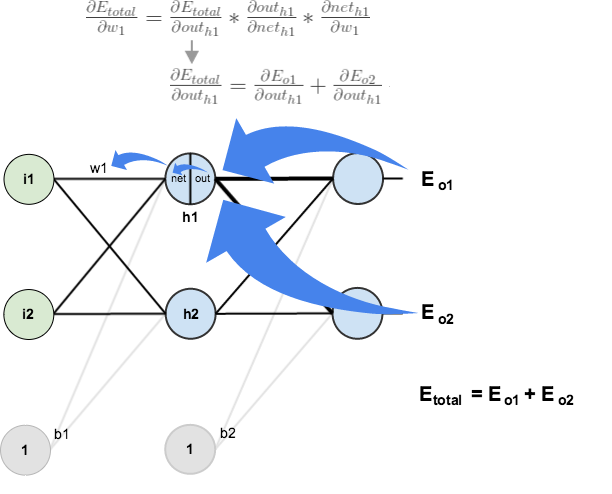
Big picture, here’s what we need to figure out:
Visually:
We’re going to use a similar process as we did for the output layer, but slightly different to account for the fact that the output of each hidden layer neuron contributes to the output (and therefore error) of multiple output neurons. We know that affects both and therefore the needs to take into consideration its effect on the both output neurons:
Starting with :
We can calculate using values we calculated earlier:
And is equal to :
Plugging them in:
Following the same process for , we get:
Therefore:
Now that we have , we need to figure out and then for each weight:
We calculate the partial derivative of the total net input to with respect to the same as we did for the output neuron:
Putting it all together:
You might also see this written as:
We can now update :
Repeating this for , , and
Finally, we’ve updated all of our weights! When we fed forward the 0.05 and 0.1 inputs originally, the error on the network was 0.298371109. After this first round of backpropagation, the total error is now down to 0.291027924. It might not seem like much, but after repeating this process 10,000 times, for example, the error plummets to 0.0000351085. At this point, when we feed forward 0.05 and 0.1, the two outputs neurons generate 0.015912196 (vs 0.01 target) and 0.984065734 (vs 0.99 target).
If you’ve made it this far and found any errors in any of the above or can think of any ways to make it clearer for future readers, don’t hesitate to drop me a note. Thanks!
And while I have you…
Again, if you liked this tutorial, please check out Emergent Mind, a site I’m building with an end goal of explaining AI/ML concepts in a similar style as this post. Feedback very much welcome!



 :
:


 we get:
 :
:


 we get:

 is included so that exponent is cancelled when we differentiate later on. The result is eventually multiplied by a learning rate anyway so it doesn’t matter that we introduce a constant here [
 (remembering that the target is 0.99) we get:

 . We want to know how much a change in
  .
. is read as “the partial derivative of
  with respect to
  “. You can also say “the gradient with respect to




 is sometimes expressed as
 , the quantity
  becomes zero because

 change with respect to



 and
and  which can be written as
  , aka
, aka  (the Greek letter delta) aka the node delta. We can use this to rewrite the calculation above:


 so it would be written as:

 (alpha) to represent the learning rate,
  (eta), and
  (epsilon).
 ,
,  , and
, and  :
:


 ,
,  ,
,  , and
, and  .
.
 affects both
  and
and  therefore the
  needs to take into consideration its effect on the both output neurons:
 :
:
 using values we calculated earlier:
 is equal to

 , we get:

 and then
  for each weight:











 Matt Mazur