
Creating a life that reflects your values and satisfies your soul is a rare achievement. In a culture that relentlessly promotes avarice and excess as the good life, a person happy doing his own work is usually considered an eccentric, if not a subversive. Ambition is only understood if it’s to rise to the top of some imaginary ladder of success. Someone who takes an undemanding job because it affords him the time to pursue other interests and activities is considered a flake. A person who abandons a career in order to stay home and raise children is considered not to be living up to his potential-as if a job title and salary are the sole measure of human worth.

You’ll be told in a hundred ways, some subtle and some not, to keep climbing, and never be satisfied with where you are, who you are, and what you’re doing. There are a million ways to sell yourself out, and I guarantee you’ll hear about them.

From Some Thoughts on The Real World By One Who Glimpsed It And Fled, a commencement speech by Bill Watterson, the creator of Calvin and Hobbes, in 1990.
Reb Zusha was laying on his deathbed surrounded by his disciples. He was crying and no one could comfort him. One student asked his Rebbe, “Why do you cry? You were almost as wise as Moses and as kind as Abraham.” Reb Zusha answered, “When I pass from this world and appear before the Heavenly Tribunal, they won’t ask me, ‘Zusha, why weren’t you as wise as Moses or as kind as Abraham,’ rather, they will ask me, ‘Zusha, why weren’t you Zusha?’ Why didn’t I fulfill my potential, why didn’t I follow the path that could have been mine.

Via Ed Weissman on an old HackerNews discussion about Paul Buchheit’s I Am Nothing essay.

There are a lot of good thoughts in the other HackerNews comments too. Worth checking out.

Understand the Problem First

I make a mistake fairly frequently where I attempt to solve problems without fully understanding them first. The process almost always goes something like this:

  1. There is a problem that needs to be solved.
  2. I mistakenly assume that I know enough to solve it.
  3. I spend a lot of time trying to solve it.
  4. I eventually realize that I do not understand the problem well and that my solution does not actually solve it.
  5. I start over and make sure I understand the problem before trying to come up with a solution.
  6. With a better understanding of the problem, I’m either able to come up with a good solution or realize that I’m not able to.

I can think of many, many examples where I’ve fallen into this trap.

Lean Designs, a web design tool that I spent more than a year building, fit this perfectly. I thought I understood what features designers wanted in a web design tool and then confidently proceeded to build it without talking to any actual designers first (doh!). Only after a lot of time and money did I realize that I had made a lot of faulty assumptions and that the tool I had built did not solve any problems that designers actually had.

I’ve found that while managing people it’s easy to make this mistake too. For example, I once supervised two Airmen who fought constantly. I had heard from a co-worker that one of the Airmen, a young woman, thought her co-worker, a guy, lacked the technical skill to be in the position he was in. Without talking to either about the underlying issue, I assumed that this story was true and tried pairing them together so that they could learn from one another. When that didn’t work, I sat down with each person individually and learned from the woman that at some point in the past the guy had said something that made her think he was a racist (she was black and he was white) and that had caused her to be hostile towards him, which in turn caused him to be hostile towards her. When I asked the guy about this, he assured me he wasn’t (and I believed him) and he later apologized to her and from that moment on they got along much better. My first solution, pairing them together did not solve anything because it was attempting to solve the wrong problem.

For another example, just yesterday a coworker asked me for some help with a library that I had worked heavily on in the past. I quickly glanced at his code and confidently offered a few suggestions on how to improve it. He made the changes and was ready to deploy them when something caught my eye and I realized that the library might not be necessary in the first place. We wound up coming up with a much simpler solution that didn’t use the library at all.

If you find yourself making the same mistake, I try to remind myself that there’s no rush and that I’ll usually save time by making sure that I thoroughly understand the problem well before trying to come up with a solution. If you’re helping someone else, they’ll likely appreciate it too :)

Saving $X Per Week Nets You $752X After 10 Years

I’ve been slowly making my way through Mr. Money Mustache’s blog archive — something I encourage everyone to check out — and it’s been an incredibly eye opening experience.

Take this, for example:

A Starbucks habit of picking up a regular coffee and biscotti on the way to work each workday. $4/day = $20/week = $15,040 in coffee over just ten years!!

Without compounding, $4/day = $20/week = $1,040/year or $10,400 after ten years. However, to calculate it’s actual future value you have to take into account what would happen if you invested that $20/week instead.

He provides a helpful shortcut for calculating the future value assuming 7% growth compounded over 10 years:

To calculate a weekly expense compounded over ten years, multiply the price by 752. For a monthly expense, multiply by 173.

752 * $20 equals the $15,040 he calculated.

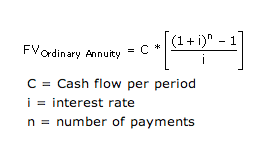
Curious, I looked into the math behind this. He provides a link to Future Value Calculator which derives the formula for an ordinary annuity, though I found this explanation on Investopedia much easier to follow.

Where does that 752 come from? From the Investopedia article:

future_value

In this case the interest is not 7% but 7% divided by 52 weeks per year, and the number of payments is 52 weeks per year multiplied by 10 years.

The future value then is:

FV = C*[ \frac{(1+\frac{0.07}{52})^{52*10}-1}{\frac{0.07}{52}} ]

Or, more simply:

FV = C * 752.34

That’s where the 752 comes from.

Similarly, the future value after 10 years of monthly savings is:

FV = C*[ \frac{(1+\frac{0.07}{12})^{12*10}-1}{\frac{0.07}{12}} ]

FV = C * 173.08

What’s amazing is that $15K is just by saving $20/week. If you can save $100/week instead, you’ll net about $75,200 after ten years. Pretty crazy isn’t it?