Growth Tip: Email newsletter subscribers who haven’t tried your product to understand why not

If you have a newsletter that includes people who haven’t tried your product, you can learn a lot by emailing those people and asking why they haven’t tried your product.

It helps you understand not just about where they may be from a sales opportunity perspective, but also to learn about their perception of your product. For example, maybe they don’t know about your product, or thought it worked in a different way, or thought it was comparable to a product they already use, or didn’t realize it could help them, or thought it did something completely different than what it actually does. You can then use what you learn to optimize your sales and marketing efforts.

Hat-tip Tim Thyne for the insight.

Edit: And also hat-tip to John Bonini, Director of Marketing at Databox, for sharing the idea with Tim.

On the Benefits to Customers of Paying Annually

Highlights from a discussion at Help Scout about the benefits to customers of paying annually:

  • Finance teams will plan or budget for their teams web apps cost for the year.
  • Similarly, most managers prefer to know their budgeted spend and to make that spend upfront. It helps them avoid mid-year “I need more money to pay for our software” surprises.
  • This also helps managers secure their budget and get their needs resourced upfront because later on they may find their budget is cut and anything that isn’t already committed can be subject to those cuts.
  • During the planning stages for purchasing software, there is often an ambitious vision for the roll out. By securing the resources/budget for an entire year, it helps the manager realize that vision.
  • The ideal behavior is letting companies prepay, but then drawing down on that credit based on usage/engagement. It helps companies avoid paying for services they aren’t using and also lets the business earn more for companies that grow during the year. (We do this at Help Scout and I’ll write a detailed post about the mechanics of it in the future.)

Hat-tip David McFarlane for these insights!

On Making it Easy for Customers to Quickly Choose the Right SaaS Plan

One of the benefits of working with so many brilliant people at Help Scout is that I’m exposed to a lot of wisdom about how to build and grow a SaaS company.

I’m going to try to start sharing more of that wisdom here, not just for my own records but to help anybody else looking to build or grow their own software business. To avoid sharing anything competetive I won’t always be able to provide context, but hopefully the quotes mostly stand for themselves.

On SaaS plans:


In self-service models, it’s really important that customers have no hesitation about which plan to choose. They need to immediately know when they look at the plans which one is right for them.

And on pricing pages:

Pricing pages are the revenue powerhouse in a self-serve model.

Using Data to Forecast the Impact of a Pricing Change

Back in April of this year Help Scout announced we would be raising prices for customers on some of our old legacy plans in six months time (in October). I recently helped with an analysis to estimate what the impact would be on our monthly recurring revenue (MRR). We performed a similar analysis prior to the announcement, but severals months had passed so it was time for fresh forecast.

At a high level, we performed the analysis as follows:

1. Identify the variables that impact the forecast

For us, this meant variables such as:

  • Of of the customers who we announced the price increase for in April, how many have churned between then and now? And how many can we expect to churn between now and October? And how many can we expect to churn after the price increase?
  • How many can we expect to upgrade or downgrade after the price increase?
  • How many can we expect to change from monthly payments to discounted annual payments?
  • Because customers pay per user, what % of users can we expect to lose after the price increase?
  • And so on.

2. Create a spreadsheet that lets you adjust the variables to see what impact they have on the forecast

For example (and simplifying a lot), if we had W customers originally and X have churned between the announcement and now, and we expect another Y to churn between now and the price increase, and we expect Z% to churn after the price increase, paying $N/month on average, we’ll wind up with a future MRR of (W – X – Y) * (1 – Z) * N.

Our actual spreadsheet wound up become quite complex to take into account all of the variables, but in the end we had something that took into account all of the key factors that impact will the outcome.

3. Come up with a range of estimates for each of variable

Using historic trends and educated guesses, we estimated the range for each of the key variables we identified. With those in hand, we create several forecasts (pessmistic, realistic, optimistic) showing what the outcome looks like for each of those situations:
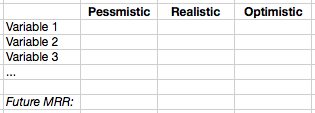
Screen Shot 2017-08-04 at 3.40.52 PM.png

My original instinct was to come back with a single number: “The forecast is $X” but my lead wisely suggested calculating several outcomes to account for the range of possibilities.

This was a fascinating exercise because it forced us understand on a deep level what the inputs are (churn rate, etc) and what impact they have on our bottom line (MRR).

If you’re interested in trying this for your business, try to create a simple spreadsheet model that takes into account various metrics (number of unique visitors, trial sign up rate, trial to paid rate, etc) that comes close to predicting your historic results, then see how it well it does going forward. You’ll likely learn a lot in the process about which metrics you need to change and by how much to achieve your growth goals.