
Background
Backpropagation is a common method for training a neural network. There is no shortage of papers online that attempt to explain how backpropagation works, but few that include an example with actual numbers. This post is my attempt to explain how it works with a concrete example that folks can compare their own calculations to in order to ensure they understand backpropagation correctly.
Backpropagation in Python
You can play around with a Python script that I wrote that implements the backpropagation algorithm in this Github repo.
Continue learning with Emergent Mind
If you find this tutorial useful and want to continue learning about AI/ML, I encourage you to check out Emergent Mind, a new website I’m working on that uses GPT-4 to surface and explain cutting-edge AI/ML papers:

In time, I hope to use AI to explain complex AI/ML topics on Emergent Mind in a style similar to what you’ll find in the tutorial below.
Now, on with the backpropagation tutorial…
Overview
For this tutorial, we’re going to use a neural network with two inputs, two hidden neurons, two output neurons. Additionally, the hidden and output neurons will include a bias.
Here’s the basic structure:

In order to have some numbers to work with, here are the initial weights, the biases, and training inputs/outputs:
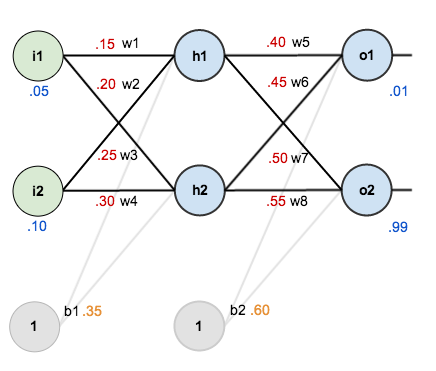
The goal of backpropagation is to optimize the weights so that the neural network can learn how to correctly map arbitrary inputs to outputs.
For the rest of this tutorial we’re going to work with a single training set: given inputs 0.05 and 0.10, we want the neural network to output 0.01 and 0.99.
The Forward Pass
To begin, lets see what the neural network currently predicts given the weights and biases above and inputs of 0.05 and 0.10. To do this we’ll feed those inputs forward though the network.
We figure out the total net input to each hidden layer neuron, squash the total net input using an activation function (here we use the logistic function), then repeat the process with the output layer neurons.
Here’s how we calculate the total net input for 


We then squash it using the logistic function to get the output of

Carrying out the same process for 

We repeat this process for the output layer neurons, using the output from the hidden layer neurons as inputs.
Here’s the output for 



And carrying out the same process for 

Calculating the Total Error
We can now calculate the error for each output neuron using the squared error function and sum them to get the total error:

 is included so that exponent is cancelled when we differentiate later on. The result is eventually multiplied by a learning rate anyway so it doesn’t matter that we introduce a constant here [1].
For example, the target output for

Repeating this process for 

The total error for the neural network is the sum of these errors:

The Backwards Pass
Our goal with backpropagation is to update each of the weights in the network so that they cause the actual output to be closer the target output, thereby minimizing the error for each output neuron and the network as a whole.
Output Layer
Consider 

 is read as “the partial derivative of
  with respect to
  “. You can also say “the gradient with respect to ”.
By applying the chain rule we know that:

Visually, here’s what we’re doing:

We need to figure out each piece in this equation.
First, how much does the total error change with respect to the output?





When we take the partial derivative of the total error with respect to 

Next, how much does the output of
The partial derivative of the logistic function is the output multiplied by 1 minus the output:


Finally, how much does the total net input of 

Putting it all together:


You’ll often see this calculation combined in the form of the delta rule:

Alternatively, we have 




Therefore:

Some sources extract the negative sign from 

To decrease the error, we then subtract this value from the current weight (optionally multiplied by some learning rate, eta, which we’ll set to 0.5):

 (alpha) to represent the learning rate, others use
  (eta), and others even use
  (epsilon).
We can repeat this process to get the new weights 





We perform the actual updates in the neural network after we have the new weights leading into the hidden layer neurons (ie, we use the original weights, not the updated weights, when we continue the backpropagation algorithm below).
Hidden Layer
Next, we’ll continue the backwards pass by calculating new values for 


Big picture, here’s what we need to figure out:

Visually:
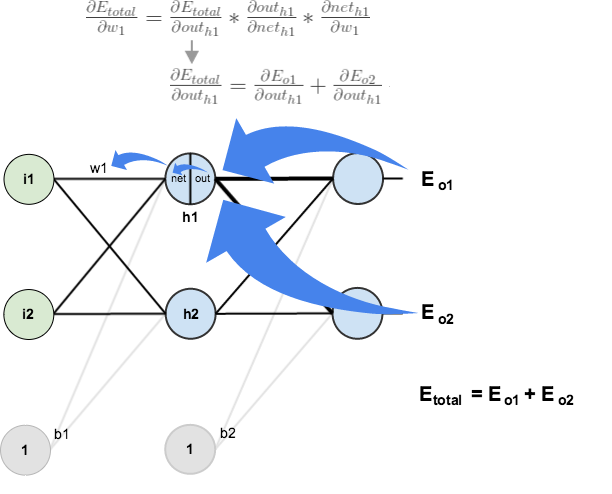
We’re going to use a similar process as we did for the output layer, but slightly different to account for the fact that the output of each hidden layer neuron contributes to the output (and therefore error) of multiple output neurons. We know that 



Starting with 

We can calculate 

And 

Plugging them in:

Following the same process for 

Therefore:

Now that we have 



We calculate the partial derivative of the total net input to


Putting it all together:

You might also see this written as:



We can now update

Repeating this for



Finally, we’ve updated all of our weights! When we fed forward the 0.05 and 0.1 inputs originally, the error on the network was 0.298371109. After this first round of backpropagation, the total error is now down to 0.291027924. It might not seem like much, but after repeating this process 10,000 times, for example, the error plummets to 0.0000351085. At this point, when we feed forward 0.05 and 0.1, the two outputs neurons generate 0.015912196 (vs 0.01 target) and 0.984065734 (vs 0.99 target).
If you’ve made it this far and found any errors in any of the above or can think of any ways to make it clearer for future readers, don’t hesitate to drop me a note. Thanks!
And while I have you…
Again, if you liked this tutorial, please check out Emergent Mind, a site I’m building with an end goal of explaining AI/ML concepts in a similar style as this post. Feedback very much welcome!
 Matt Mazur
This is how any teaching or learning has to happen! Great work buddy!
Many thanks. The best tutorial I have ever seen
It seems that the learningrate of “0.5” in this example here is too high. because it diverges with the given values. Maybe 0.05?
sorry, forgot to set the energy variable in the neuron back to zero after training
I found this post very helpful but there is one thing that is confusing me. You apply the logistic function on the output nodes to compute out_o1 and out_o2 as the sigmoid function applied to the weighted sum of the hidden nodes. My question is, what if you are predicting an output that has a range wider than 0 to 1. I had thought the output layer was simply a weighted sum of the outputs of the final hidden layer. In that case you could output a value in any range, but this seems very limiting.
Yeah, this only works on a range of 0 to 1. If you have a range from say 0 to 100 you can divide by 100 to get it down to a range of 0 to 1 so that you can use this neural network.
what does the Who mean in the expression for the hidden layers?
The “ho” is small
Weight of the hidden output.
Shouldn’t it be the weights connecting the last hidden layer and the output layer? If the network had an input of 200, hidden of 100, and another hidden of 50, and an output of 10; it wouldn’t work. Because the layer of 1 hundred would add the outputs multiplied by 10 of the 50 layer weights, right? Sorry if I am not very clear. What I’m just trying to ask is this: Is the Who referring to the weight connecting the last layer and output layer or is it connecting the current layer and next layer?
You have used a squared error function. When using that as a cost function along with the sigmoid function, won’t your cost function have a lot of local minima ?
Thanks, it’s the best and clear step by step tutorial of the backpropagation alg I have ever read
Thanks so much!! It’s a very clear and thorough explanation :)
Great Post with the step by step explanation.
Based on your explanation I am able to implement the same for LOGICAL GATE solution where I have used 2 Input Nodes (for logical Inputs), 1 Hidden Layer with 2 Nodes and one Output Node.
Thanks for this detailed explanation.
Regards
Neevan
Couldn’t agree less with Hajji.
Its one the best and simplified article.
Thanks for beautiful workout .algorithm has become transparent and very easy
Amazingly simple explanation to something everyone tends to complicate! :) Thanks a lot!!
It was a great explanation, Mazur. Thank you very much for the effort.
It would be great if you could response my following query.
I have been trying to train a model using neuralnet package. My model contains five input one output and a hidden layer with 10 nodes. logistic transfer function is selected as an activation function. All data are normalized in 0,1 range. As the logistic function is bounded between 0,1 the results are expected to be in the range 0,1. But some of the training results are negative. What is causing the model to compute negative output?
Regards
H. Paudel
How would you compute the weight for a hidden layer in a multi-layer network?
you’re the saviour!
Many thanks for tutorial!
But I have a problem, when im trying use more neurons (e.g. 20 inputs and 8 outputs) with more training data, NN total error is almost stagnates after few cycles. Any solution? (adaptive eta?)
Convert your input data to decimal values between 0 and 1 only.
Hi – Thanks much , this is the only place I got some valid information in a way I can understand. I have few questions, if you don’t can you please check these out.
Question 1:
You have tried to find derivative of Etotal WRT to W5.
In this how did you get this “-1”(Minus 1), doesn’t the derivate rule equate to following
2*1/2(targeto1-out01) ( No Minus)
Question 2:
In chain rule. To find derivative of Etotal WRT to W5 following was used.
DEtotal/Dw5 = Dnet01/Dw5 * Dout01/ Dnet01 * DEtotal/DOut01
Here please note : DOut01/Dnet01 , Out01 was used and It makes sense.
But to To find derivative of Etotal WRT to W1 following was used.
DOut01/Dnet01 was not used, why is that.
Question 1: Using chain rule, since out_01 has a negative sign before it in the parenthesis, you need to propagate (no pun intended) that negative sign. In other words:
\frac{d}{dx} {(1-x)}^2 = (-1) \times (2-1) \times {(1-x)}^{(2-1)}
Question 2:
Check out the image beneath the writing “Next, we’ll continue the backwards pass by calculating new values for w1, w2, w3, and w4”. He explains that D(E_total)/D(out_h1) = D(E_o1)/D(Out_h1) + D(E_o2)/D(Out_h1). And then he breaks out that first term, D(E_o1)/D(Out_h1), in the next images, which includes your term “DOut01/Dnet01”
Hi Hari – Thank you for your patience and answer. May be I am missing something here, on question 1.
Here derivate of E total WRT Out01 is (target01 – Out01), so the correct value is “-0.74136507”.
Minus sign stating derivative in decreasing , going in downward direction.
I am still not sure how “-0.74136507” changed to “0.74136507”
I am also not sure where the * -1 comes from, there is not a multiplication there in the non-differentiated function. It seems odd.
Question 1: Using chain rule, since out_01 has a negative sign before it in the parenthesis, you need to propagate (no pun intended) that negative sign. In other words:
\frac{d}{dx} {(1-x)}^2 = (-1) \times (2-1) \times {(1-x)}^{(2-1)}
Question 2:
Check out the image beneath the writing “Next, we’ll continue the backwards pass by calculating new values for w1, w2, w3, and w4”. He explains that D(E_total)/D(out_h1) = D(E_o1)/D(Out_h1) + D(E_o2)/D(Out_h1). And then he breaks out that first term, D(E_o1)/D(Out_h1), in the next images, which includes your term “DOut01/Dnet01”
See this explanation https://www.symbolab.com/solver/derivative-calculator/%5Cfrac%7B%5Cpartial%20%7D%7B%5Cpartial%20%20x%7D%5Cleft(%5Cleft(1-x%5Cright)%5E%7B2%7D%5Cright)
Mazur, Thank you for your explanation, but i have a little question, i have calculated exactly the same steps you described, but the second round i calculated the total error is 0.292165448
different from what you have written, i have done something wrong in your opinion?
I have a small question. From your tutorial, the node delta is calculated as
(out – target) * out (1 – out)
I tried implementing the XOR network here:
http://www.heatonresearch.com/aifh/vol3/xor_batch.html
and it fails to find the optimal weights. It turns out that the node delta in the above website is
(target – out) * out (1 – out)
Why is there a sign difference?
Thanks so much!
If you read the original 1986 paper (Learning representations by back-propagating errors), you will find that they calculate the error function in the reverse (out – target). I believe the math works out the same, but the general consensus from a variety of sources is to calculate it as -(target – out).
I would be curious what the original authors, or even Yann LeCun, has to say about this.
You allude to this curiosity early in your rundown. I figured it would be worthwhile to point out its potential origin.
Thank you =))))
I cannot thank you enough!
Thank you very much for a great lesson.
When I calculate the first forward pass i get the same output, same total error and the same value for the new weights as in your example.
But when I run a second time I get 0,291027774 instead of 0,291027924.
After 10000 turns i get 3,5109E-05 instead of 3,5085E-05
I use double as datatype and do not round the values
Reblogged this on Site Title.
This article is amazing and really helped me to understand backwards propagation! Very well-written and intuitive to follow. As a test, I tried transposing your Python code into Swift. I tested all your inputs/outputs to my program and it outputted the same numbers (save for some *very* negligible differences), so I believe it’s constructed correctly. Even when testing your very last paragraph (inputs: 0.05, 0.1, expected outputs: 0.01, 0.99, backwards propagated 10,000 times) it ended up with the same output. However, I’m having some trouble training it to do other things.
To play with it, I decided to train it with OR operator testing inputs. I gave it two input neurons, five hidden neurons, and one output neuron. The tests were:
network.train(inputs: [0,0], expectedOutputs: [0])
network.train(inputs: [0,1], expectedOutputs: [1])
network.train(inputs: [1,0], expectedOutputs: [1])
network.train(inputs: [1,1], expectedOutputs: [0])
And I had the program repeat these 4 lines of code 10,000 times. At the end, when I forward propagated it, all the outputs were about 0.5 (making the error margin approximately 0.5) and it the outputs barely changed since the beginning! What’s up with this? Am I not training it correctly, or would something be wrong with my code? I can upload the source if that will help.
Thank you so much to whoever can help.
Hi,
I had the same issue. I believe that the node delta has the wrong sign. It should be (target – out) instead of -(target – out).
If you change the sign then it should work. Here’s another useful website for checking your calculations:
http://www.heatonresearch.com/aifh/vol3/xor_batch.html
If you build a similar XOR network, every time you click “Train batch epoch” the web build display all relevant calculations.
Once you switch the sign, all logical operators work. :D
Please help me to answer this question. I’m confusing with calculation partial derivative of Eo2 with respect outo1 (dE02/dOut01).
You wrote: “Following the same process for dE02/dOut01, we get: dE02/dOuth1=-0.019049119”
E02 = 1/2(target02 – out02)^2, therefore the partial derivative of E02 with respect out01 will be 0. So how can you get
dE02/dOuth1=-0.019049119?
Thank you in advance!
I’ve bookmarked this and have come back so many times I just have to let you know how awesome it is.
Can someone PLEASE explain to me how this got calculated?
https://s0.wp.com/latex.php?latex=%5Cfrac%7B%5Cpartial+E_%7Btotal%7D%7D%7B%5Cpartial+out_%7Bo1%7D%7D+%3D+2+%2A+%5Cfrac%7B1%7D%7B2%7D%28target_%7Bo1%7D+-+out_%7Bo1%7D%29%5E%7B2+-+1%7D+%2A+-1+%2B+0&bg=ffffff&fg=404040&s=0
Ok I got it
Your explanation is very nice sir. I think you can add little more derivation. Likr after applying the penalty term (theta exponent T theta)to error function what wil be the derivation
Why is dError/dHidden1 calculated without including the net_o1 and out_o1?
nice blog! hope for next addition can related this algorithm to coding(Python,c
++) or show how the vectorization works
When you calculate neth1 shouldn’t you be multiplying 0.25 with 0.1 instead of 0.2?
Similarly for neto1, you should be multiplying w7 with out h2 because that is the input of o1 instead of w6.
The most clear explanation of back propagation i have come across.
Wow…very simple explanation for such a complicated process…
Thanks
thank you very much
it was so good :D
Really great tutorial. How would the pattern of back propagation carry on with multiple hidden layers instead of just the one? What would the overall algorithm look like where the hidden layer count, weights, etc, are all variable?
I also would be very interested in the answer!
OMG you saved my life!
Thank you an amazing article! Everywhere else the description of the algorithm is extremely theoretically, so I am glad that you got your hands dirty by really describing the actual implementation with numbers and not just by loads of symbols, which particularly in the case of backpropagation was very confusing for me. Cheers from Edinburgh.
Having a read now – seems really helpful. Thank you!
Hello Caspar, did you get information about how to implement it for multiple hidden layer ? I am also looking for this. Thank you.
https://github.com/jovianlin/siraj-intro-to-DL-02/blob/master/MultiLayerNeuralNetwork.ipynb
Thanks for great article!
Question: how do we tune the weights of biases?
Yes how do we find the updated biases??
Hi there,
I think those are same with same layer’s weight but the output value won’t update.( in example suppose 1 for biases weight )
Sorry Matt please update my post with this:
Hi there,
I think those are same with same layer’s weight but the value of biases won’t update.( in example supposed 1 for biases weight )
Nicely explained ! :) Thank you.
great
Thanks alot for such a wonderful explanation.