
Background
Backpropagation is a common method for training a neural network. There is no shortage of papers online that attempt to explain how backpropagation works, but few that include an example with actual numbers. This post is my attempt to explain how it works with a concrete example that folks can compare their own calculations to in order to ensure they understand backpropagation correctly.
Backpropagation in Python
You can play around with a Python script that I wrote that implements the backpropagation algorithm in this Github repo.
Continue learning with Emergent Mind
If you find this tutorial useful and want to continue learning about AI/ML, I encourage you to check out Emergent Mind, a new website I’m working on that uses GPT-4 to surface and explain cutting-edge AI/ML papers:

In time, I hope to use AI to explain complex AI/ML topics on Emergent Mind in a style similar to what you’ll find in the tutorial below.
Now, on with the backpropagation tutorial…
Overview
For this tutorial, we’re going to use a neural network with two inputs, two hidden neurons, two output neurons. Additionally, the hidden and output neurons will include a bias.
Here’s the basic structure:

In order to have some numbers to work with, here are the initial weights, the biases, and training inputs/outputs:
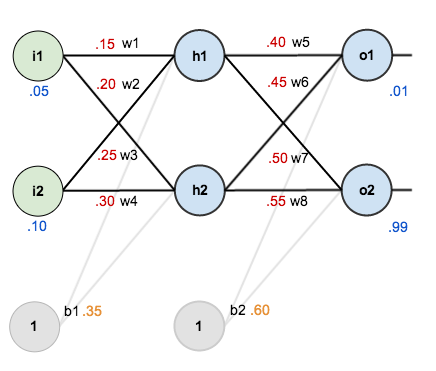
The goal of backpropagation is to optimize the weights so that the neural network can learn how to correctly map arbitrary inputs to outputs.
For the rest of this tutorial we’re going to work with a single training set: given inputs 0.05 and 0.10, we want the neural network to output 0.01 and 0.99.
The Forward Pass
To begin, lets see what the neural network currently predicts given the weights and biases above and inputs of 0.05 and 0.10. To do this we’ll feed those inputs forward though the network.
We figure out the total net input to each hidden layer neuron, squash the total net input using an activation function (here we use the logistic function), then repeat the process with the output layer neurons.
Here’s how we calculate the total net input for 


We then squash it using the logistic function to get the output of

Carrying out the same process for 

We repeat this process for the output layer neurons, using the output from the hidden layer neurons as inputs.
Here’s the output for 



And carrying out the same process for 

Calculating the Total Error
We can now calculate the error for each output neuron using the squared error function and sum them to get the total error:

 is included so that exponent is cancelled when we differentiate later on. The result is eventually multiplied by a learning rate anyway so it doesn’t matter that we introduce a constant here [1].
For example, the target output for

Repeating this process for 

The total error for the neural network is the sum of these errors:

The Backwards Pass
Our goal with backpropagation is to update each of the weights in the network so that they cause the actual output to be closer the target output, thereby minimizing the error for each output neuron and the network as a whole.
Output Layer
Consider 

 is read as “the partial derivative of
  with respect to
  “. You can also say “the gradient with respect to ”.
By applying the chain rule we know that:

Visually, here’s what we’re doing:

We need to figure out each piece in this equation.
First, how much does the total error change with respect to the output?





When we take the partial derivative of the total error with respect to 

Next, how much does the output of
The partial derivative of the logistic function is the output multiplied by 1 minus the output:


Finally, how much does the total net input of 

Putting it all together:


You’ll often see this calculation combined in the form of the delta rule:

Alternatively, we have 




Therefore:

Some sources extract the negative sign from 

To decrease the error, we then subtract this value from the current weight (optionally multiplied by some learning rate, eta, which we’ll set to 0.5):

 (alpha) to represent the learning rate, others use
  (eta), and others even use
  (epsilon).
We can repeat this process to get the new weights 





We perform the actual updates in the neural network after we have the new weights leading into the hidden layer neurons (ie, we use the original weights, not the updated weights, when we continue the backpropagation algorithm below).
Hidden Layer
Next, we’ll continue the backwards pass by calculating new values for 


Big picture, here’s what we need to figure out:

Visually:
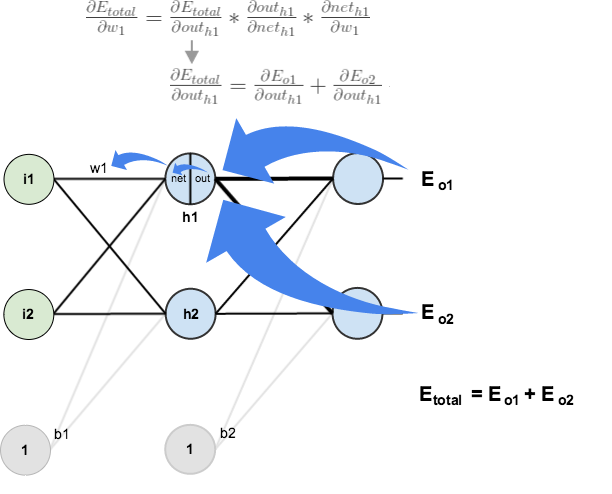
We’re going to use a similar process as we did for the output layer, but slightly different to account for the fact that the output of each hidden layer neuron contributes to the output (and therefore error) of multiple output neurons. We know that 



Starting with 

We can calculate 

And 

Plugging them in:

Following the same process for 

Therefore:

Now that we have 



We calculate the partial derivative of the total net input to


Putting it all together:

You might also see this written as:



We can now update

Repeating this for



Finally, we’ve updated all of our weights! When we fed forward the 0.05 and 0.1 inputs originally, the error on the network was 0.298371109. After this first round of backpropagation, the total error is now down to 0.291027924. It might not seem like much, but after repeating this process 10,000 times, for example, the error plummets to 0.0000351085. At this point, when we feed forward 0.05 and 0.1, the two outputs neurons generate 0.015912196 (vs 0.01 target) and 0.984065734 (vs 0.99 target).
If you’ve made it this far and found any errors in any of the above or can think of any ways to make it clearer for future readers, don’t hesitate to drop me a note. Thanks!
And while I have you…
Again, if you liked this tutorial, please check out Emergent Mind, a site I’m building with an end goal of explaining AI/ML concepts in a similar style as this post. Feedback very much welcome!
 Matt Mazur
This is really great. Like the others I have 2 questions. Why aren’t you updating the bias weights, and when moving to w1-w4, should we use the original w5-w8 or the new updated ones?
Thanks for this article….But i would like to know how performing backpropagation using deep learning? if you can give me an example of how training a DB of n 2D images.
Great work. I was able to develop my first net using your tutorial as a test case. One question: using Etotal one can update weights for the output layer. Then using both E1 and E2 one can update weights for the hidden layer. What would you use for errors if you had more then one hidden layer (same E1 and E2?)
spreadsheet implementation, messy but the #’s work
https://docs.google.com/spreadsheets/d/1ashrhJsLaCgusiJM2n_Y-zB5Usshxp9jIrNJbf-_vwU/edit?usp=sharing
Messy but brilliant. Was about to do it in Excel so you saved me a weekend. Thank you. Well done.
thank you very much for best example
Wow. could not ask for much granular level explanation. Thanks so much.
Thanks for this useful explanation. I have a doubt if you have the time. Can the same back propagation be modified slightly to work with a convolution neural net. Any comments would be very helpful.
At the start of backward propgation, why is the E_total being considered for partial derivative with respect to w5. Shouldn’t it just be E_01? (Since E_02 doesn’t have any effect of changing w5).
Matt good explanation. One quick question is that you pointed out after 10k iteration the error should drop. Does that mean to repeat with same instance (ie i1 is 0.05 and i2 is 0.10) or do you randomly generate i1=2*i2 where 0<i1<0.45 of 10k instances
Hi,
While calculating H1 should we not use the weight 0.25 and not 0.20
Nope, I had the same issue, but the sketch of the net is a little bit confusing.
“Maa Shaa Allah”, Great Skills. First time i understood completely what is Back propagation. I am PhD student @ bsauniv.ac.in
At the end I have understood backpropagation. Thank you
Thanks to your simple explanation of backpropagation I was able to successfully build a neural network in java. You have the best explanation of this stuff on the internet!
Sir, first of all, it is very clear. However; I think you should use the updated weights for the next training input not the same input.
Can you kindly clarify that?
Thanks Matt. This is very helpful. I a newbie question. How that the NN is trained how can i use this code to give me an output of 0.01,0.99 when the input is 0.05,0.1
it is cool! thx!
What are the weights after the 10,000 iteration?
Hi, first I´d like to thank you. this tutorial made everything clear to me and helped me building my neural network.
But, I have a question, What book or referencee did you use to learn to develope this tutorial ? I really liked the way you exposed the topic, so I wanted to learn a little bit more.
Hoping for hearing from you soon.
Reblogged this on Diplomado La Ciencia en tu Escuela.
great work , thanks
This truly is an amazing explanation of backpropogation!
I’m stuck on one thing though, and I could really use some help. Just after this statement:
>>First, how much does the total error change with respect to the output?
There’s a negative one (-1) in the formula of the partial derivative that I can’t for the life of me figure out where it’s coming from.
Any help is greatly appreciated, thanks so much!
A bit late, but hope this helps:
The -1 is a result of the chain rule. Let target[o1] be x and out[o1] be y. Then the expression we want to differentiate (ignoring the output and target of o2) is (1/2)*(x – y)^2. We first find the derivative of the outer expression (using the power rule): 2*(1/2)*(x – y), which simplifies to (x – y). We need to continue differentiating, however, because x is constant and does not vary with y. So the derivative of -y is -1. Then, by the chain rule, we multiply the derivatives of inner and outer expressions: (x-y)*-1. That’s where the -1 comes from! Hope this helps!
I had this confusion too. Thanks for clarifying.
Yes, perfect, thanks so much!
Yes, thanks so much!
Thank you so much. It was very helpful and clear.
Thanks much – this is very helpful. But one question: Shouldn’t the b1 and b2 values also get updated during the back propagation? Or did I miss that?
Thanks a lot. You clearly explained everything.
Thanks so much. Finally I understand backprop.
Nice tutorial, well explained!
In backpropagation how is E_o2/out_h1 = -0.019049119 is calculated? What is the chain rule equation for this? i am not getting how to relate error E_02 and h_1. Kindly help me
I’m getting -0.0171442..
your the man brooo thanks ….
Reblogged this on ARTA Story.
Very good example, thank you very much!
It is very detail of Backpropagation NN, Thanks!
and, I has a question to more detail:
In this example, you had only one pattern {0.5, 0.1}, so you repeated the training many times on the pattern. If I have a patterns vector (many pattern to input), then at each repeating, we will use next pattern (of the vector)?
one more, Thanks!
I want to be able to create a neural net that can recognize voiced phonemes. This means that I will not know how many A-to-D samples I will get until the pattern completes. I guess a network could check sample by sample, returning a FAIL, until the phoneme finishes. Do you have any ideas?
Where you’re calculating the derivative of netO1 with respect to w5, you’re taking w5 to the power of (1-1) which should be to the power of 0, which should be equal to just 1. Instead, you put .59 (the value of w5) there. What gives?
Nice tutorial, well explained!
Thanks a ton!!
Thank you so much for your post!!! I really appreciate it!
Matt
I am very new to ML but I am ok with Math. Thank so much for a very good illustration. Made so much more sense to me. To many tutorials remove the rigorous treatment you put in.
Thank you.
Mike, Cape Town, South Africa
Ps: Have you thought of doing this with an Excel as well?
Thank you! This help me find a mistake in my neural network implementation. I added a unittest making sure a backpropagation step produces just these outputs.
Thank you very much! It helps a lot! Very useful article!
what is the use of bias in neural networks?
it would be great Matt sir if you elaborate my doubt with another brilliant example.
Hi Anuj,
With my experience, I find 2 reasons for use bias. before explain those let me say bias it not useful to all network we design.
reason 1: If you look at bias you see that bias doesn’t contact with inputs and just update with other weights because of this biasses make such a momentum in the network and help network doesn’t stick in very small local minimums.
reason 2: In some cases, bias can help to ignore such a calculation errors, by that I mean for instance you have less chance to have sig( sum=0 ). I should say that again I have some network that doesn’t have any bias.
Nice supplement especially for a beginnner who has started with Andrew Ng course. Example makes it clear. Thank you
Are you also stuck while computing the backpropagation derivatives? :D (Yeah, following Andrew Ng course too ;))
It is very useful ever for me, thank you so much.
Hey, thanks for the clear explanation.
Can I see the snapshot of dataset that could have been considered in this case. Even the first 5 rows would be good for me.
Thanks
Hi All,
I need a very basic clarification here. From one training example considered here we see that we have two input neurons as two attributes, two units in the hidden layer but in the output layer we have two output neurons.
Are we trying to predict the values of two dependent target variables from two independent variables in this case. Two output neurons for the case of linear regression problem where we predicts the value of one target variable based on multiple independent variables confuses me here!!
Anyone please help me in clarifying this!! Let me know for any clarifications.
This is the most likely a classification case, where logistic regression is used. So o1 and o2 are 2 different classes. For example if the input is an image(pixels), and we have to recognise whether the image is of an apple or orange. Then we may represent o1 as an apple and o2 as an orange i.e if the image is an apple then [o1, o2] = [1, 0] & if the image is an apple then [o1, o2] = [0, 1].
I hope this answers your question, if I haven’t misinterpreted it.
Very very nice!!!
Your explanation is the easiest one to understand!!!
The best thing is that you pointed out the chain rule. That is the key to understanding backpropagation.
This was very good, thanks a lot. The example with numbers really helped.
Here is more, in the same vein: https://web.archive.org/web/20150317210621/https://www4.rgu.ac.uk/files/chapter3%20-%20bp.pdf
However, Matt’s explanation is a bit clearer, perhaps. Neither handles bias correctly. As others have pointed out, I think Matt needs to calculate a delta for all the biases too. See https://stackoverflow.com/questions/3775032/how-to-update-the-bias-in-neural-network-backpropagation
I think the method in PDF link is incorrect. The author back-propagated the errors to the hidden layer with the newly updated weights instead of the current ones.
I made my own code to test the same case. Updated weights were not used during back propations at all. And I got the same numbers shown here including the remained error after 10,000 iterations.
thanks a lot for your explanation